
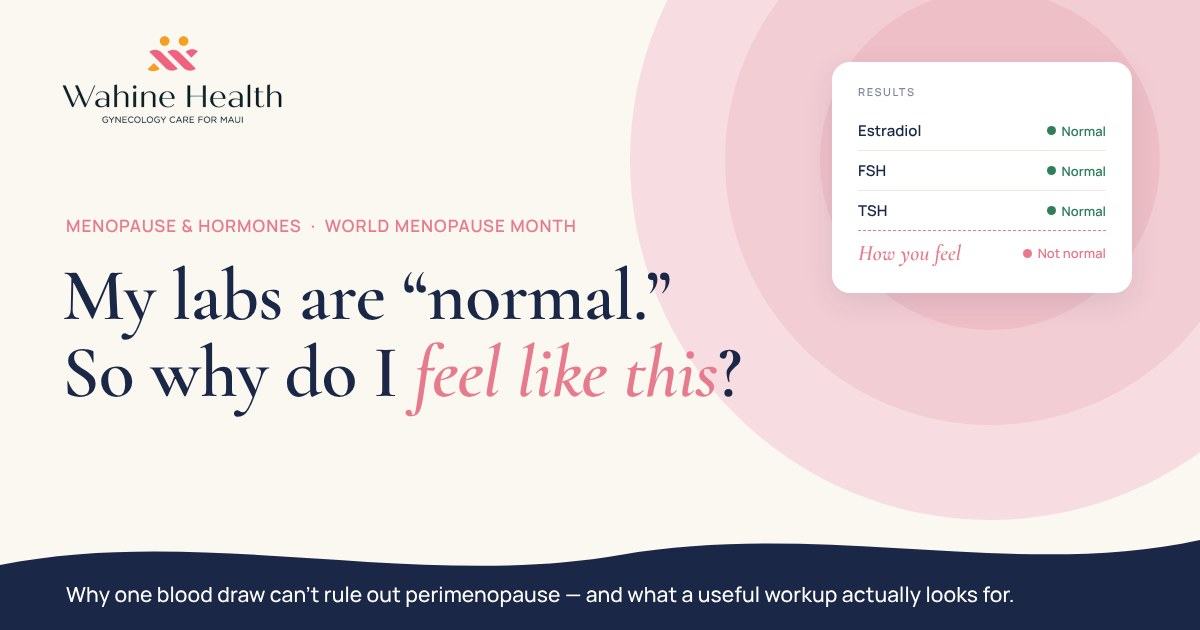
You finally said it out loud. The sleep that stopped working, the 3 a.m. wake-ups, the word that vanishes mid-sentence, the joints, the mood, the cycle that no longer keeps its own schedule. Someone drew your blood. And the message came back: everything looks normal. Maybe with an offer of an antidepressant. Maybe with “let’s recheck in a year.”
So now you are holding a lab report that says you are fine and a body that says you are not, and you are wondering which one to believe.
Believe the body. Not because the lab is wrong — the number is probably accurate — but because a hormone level was never the right tool for the question you were asking. This month is World Menopause Month, and this year’s message from the International Menopause Society is that women’s symptoms should not be dismissed or written off as ageing. “Your labs are normal” is the most common way that dismissal happens, and it is worth understanding exactly why it misses.
Perimenopause is defined by fluctuation. A blood test is a snapshot.
The ovaries do not wind down on a smooth slope. In the years before the final period they become erratic: a cycle with a surge of estrogen higher than anything you made at 30, then a cycle with almost none, then a cycle that looks textbook. FSH, the brain’s signal to the ovary, rises when the ovary is quiet and falls back when it responds. Both numbers can be high on Tuesday and squarely “normal” on Friday — in the same woman, with the same symptoms.
That is not a flaw in the test. It is the biology of the transition. A single draw tells you where you were at 8:40 that morning, and nothing about the pattern that is actually producing your symptoms.
This is why every major body that sets the standard of care — The Menopause Society, ACOG, and the UK’s NICE guideline — says the same thing: in a woman over 45 with typical symptoms, perimenopause is a clinical diagnosis. It is made from your symptoms and your cycle pattern, not from a hormone level. NICE goes further and says FSH should not be used to make the diagnosis in women over 45 at all. The staging system clinicians use (called STRAW+10) stages the transition by what your periods are doing — not by any number on a lab slip. If you are on hormonal contraception, a hormone level is even less informative, because the pill or the IUD is quietly flattening the very signal the test is trying to read.
“Normal” is a population range, not your range
The reference range printed next to your result was built from a large group of women. It is wide on purpose — the “normal” span for estradiol during the first half of a cycle covers a several-fold difference from bottom to top. A woman who has spent twenty-five years at the upper end of that range and has now drifted to the lower end is still, on paper, normal. Her brain, which calibrated itself to the higher level, disagrees.
Symptoms track change and withdrawal more than they track any absolute number. The hot flash is the clearest example: the cluster of neurons in the hypothalamus that acts as the body’s thermostat is exquisitely sensitive to estrogen falling. It fires during the drop. Whether the level it dropped to happens to sit inside a printed range is beside the point. The same logic applies to the 3 a.m. wake-up, the word-finding, and much of the mood change women describe in their 40s.
What labs are actually for: ruling out the look-alikes
None of this means blood work is pointless. It means it answers a different question. We do not draw labs to prove you are in perimenopause. We draw them to make sure something else is not also going on — because the symptom list of the transition overlaps almost completely with several conditions that are easy to miss and very treatable.
Thyroid. An underactive or overactive thyroid produces fatigue, weight change, mood change, sleep disruption, hair shedding and cycle changes. It peaks in exactly this decade.
Iron — ferritin, not just hemoglobin. Years of heavier periods quietly empty the iron stores long before anemia shows. Low ferritin alone causes exhaustion, breathlessness, restless legs and poor concentration.
Blood sugar. An A1c or fasting glucose, because insulin sensitivity shifts in midlife and the fatigue and weight change can look hormonal.
Vitamin D, and B12 when indicated. Common, cheap, and relevant to bone, mood and energy.
A pregnancy test, when the cycle has gone unpredictable and it is still possible.
And then the things no blood test shows, which an unhurried history does: sleep apnea, which rises sharply in women after menopause and is routinely missed because it does not look the way it does in men; depression and anxiety, which are real, treatable, and can sit alongside perimenopause rather than instead of it; and medication effects, since several common prescriptions cause sweats, weight change or low libido on their own.
When all of that comes back clean, that is not a dead end. It is good news that narrows the field — and makes the clinical diagnosis stronger, not weaker.
Book a visit — Wailea or telehealthIn office in Wailea, or by telehealth in Hawaiʻi & Illinois.
When hormone levels do earn their place
There are situations where measuring hormones genuinely helps, and a good clinician knows which they are. Under 40, when symptoms or absent periods raise the question of premature ovarian insufficiency, two FSH values drawn several weeks apart are part of the diagnosis. Between 40 and 45, when the picture is atypical. After a hysterectomy with the ovaries left in place, when there are no periods to read the pattern from. And occasionally once treatment has started, to confirm that a patch or gel is being absorbed. In each of these the level is answering a specific question — not standing in for the whole conversation.
One more number worth a word, because so many women are told “your testosterone is normal” and sent away: there is no validated testosterone level that defines deficiency in women. Low desire is diagnosed clinically. When we measure testosterone it is for a baseline and for safety during treatment, not to decide whether you qualify. More on that here.
We treat the woman, not the number
If, after all of that, perimenopause is the diagnosis, the next step is to talk about what would actually help — which may or may not include hormones, and if it does, the dose is adjusted to how you feel, not to a target on a lab slip. There is no universal estradiol number every woman should be chasing, and anyone who promises you one is simplifying. What there is: your symptoms, your history, your preferences, and a clinician who takes all three seriously. That is the whole method. (A fuller explanation of the options lives on our menopause and hormone therapy page.)
What to say at your next visit
If you have already been told your labs are fine, you do not have to argue with the lab. You can simply reframe the question:
“I understand my hormone levels came back in range. I’d like to be evaluated clinically for perimenopause based on my symptoms and my cycle pattern, and to make sure thyroid and iron have been checked.”
Bring a rough timeline of what changed and when, a few months of cycle notes if you have them, and the 3-minute symptom check-in on this site, which scores the same domains clinicians use. If the response is still “the labs are normal,” here is how to find someone trained in this.
Where that leaves you
A normal lab result and a woman who feels nothing like herself are not in conflict. They are the expected picture of perimenopause, and the discomfort you feel reading “within normal limits” is not you being difficult. It is the right instinct. Your symptoms are data. They deserve a workup that was designed for them.
Common questions
Can my hormone levels be normal and I’m still in perimenopause? Yes, and it is the most common presentation. Estrogen and FSH swing from cycle to cycle, sometimes day to day, through the transition, so a single draw often lands inside the reference range. In women over 45, perimenopause is diagnosed from symptoms and cycle pattern, not from a blood test.
Should I ask for an FSH test to see if I’m in perimenopause? Usually not if you are over 45 and still having periods — major guidelines, including NICE, advise against using FSH for the diagnosis in that group because it fluctuates too much to be reliable. FSH is useful under 40 to evaluate premature ovarian insufficiency, sometimes between 40 and 45, and after a hysterectomy when there is no cycle to read.
Then what blood tests are worth doing? The ones that rule out conditions that mimic perimenopause: thyroid function, ferritin (iron stores) and a blood count, an A1c or fasting glucose, vitamin D, and B12 or a pregnancy test when indicated. Sleep apnea, mood disorders and medication side effects are screened for by history, not by blood.
Is there a “normal” testosterone level for women? No validated level defines deficiency in women. Low sexual desire is diagnosed clinically. A testosterone level is drawn before treatment for a baseline and during treatment for safety, not to decide whether someone qualifies.
If I start hormone therapy, will you check my levels to adjust the dose? For most women, dosing is guided by symptom response rather than by a target level, and no single estradiol number is right for everyone. Levels are occasionally checked to confirm a patch or gel is being absorbed. The goal is how you feel, with the lowest effective dose for your situation.
Menopause & Hormones · Wailea, Maui
Been told your labs are fine?
Perimenopause is diagnosed clinically — from your symptoms and your cycle, by a Menopause Society Certified Practitioner who also rules out what else could be going on. In office in Wailea, or an initial visit by telehealth.
Book a visit Menopause & hormone therapy Take the 3-minute symptom check-in