
You're mid-sentence and the word is simply gone. Not on the tip of your tongue — gone. You cover for it, you finish the thought some other way, and you keep going. But part of you files it away.
Then it's the name of someone you've known for fifteen years. Then it's walking into the kitchen with no idea why. Then it's re-reading the same paragraph three times.
Most wāhine don't bring this up at their annual visit. They Google it at 2 a.m. instead, and what they find is frightening.
So let's start with the reassuring part: what you're describing is one of the most common and most under-discussed features of the menopause transition. About two-thirds of women report memory changes as they move through it. You are not an outlier — and for the overwhelming majority of women describing exactly this, it is not dementia.
Estrogen is a brain hormone
We talk about estrogen as a reproductive hormone, and that framing does women a disservice. Estrogen receptors are widely distributed through the brain — in the hippocampus, where new memories are consolidated; in the frontal cortex, which drives attention and the effortful search for a word; and in the posterior cingulate, which carries some of the highest receptor density measured in living women and is among the first regions to show metabolic change in Alzheimer's disease.
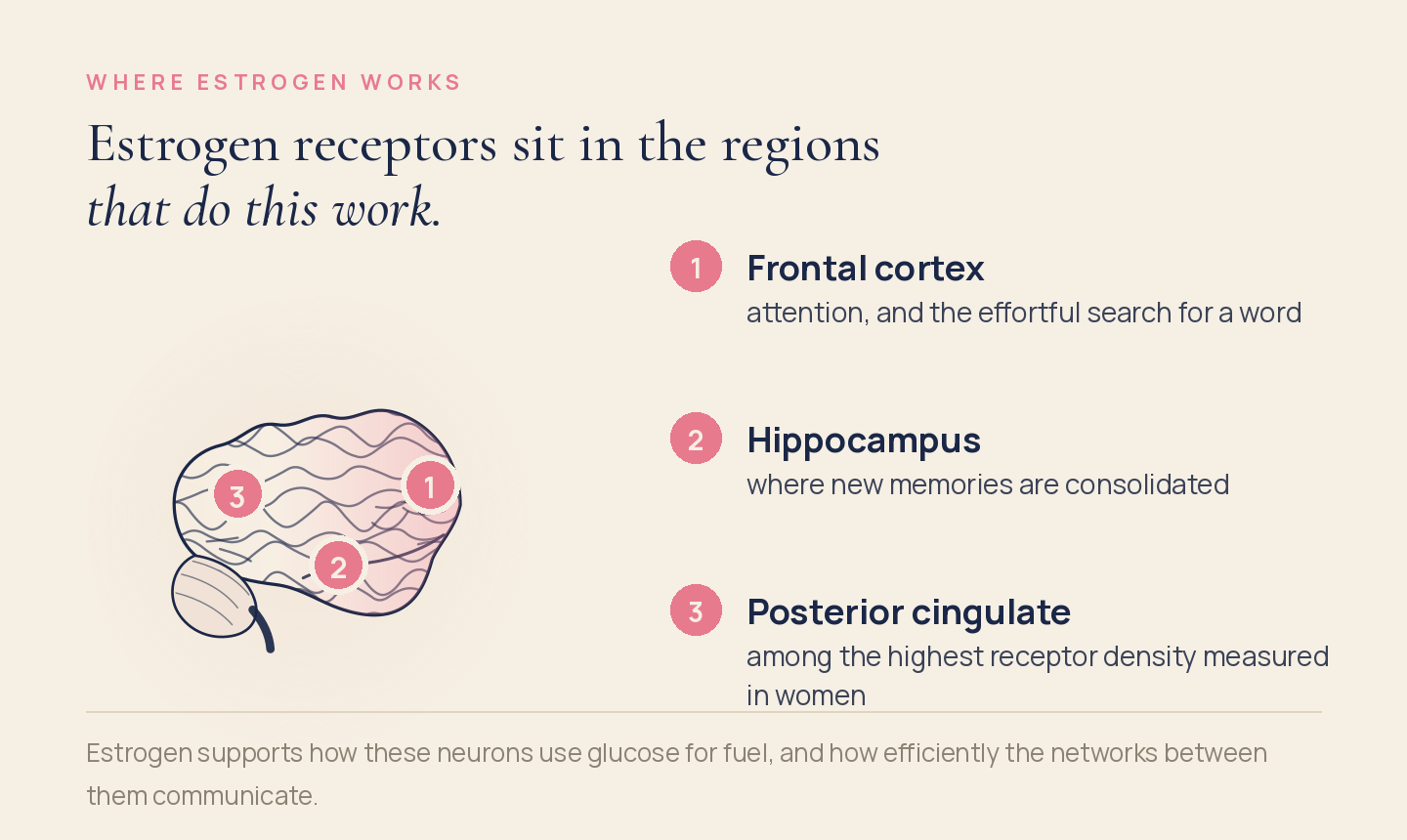
Estrogen isn't decorative in those regions. It supports how neurons use glucose for fuel, how readily they form new connections, and how efficiently networks communicate. Neuroimaging work in research cohorts has shown measurable shifts in brain energy metabolism and connectivity across the menopause transition.
So when estrogen stops arriving on a predictable schedule — and in perimenopause it doesn't decline in a tidy line, it spikes and crashes, sometimes within the same week — the brain regions that depend on it feel the turbulence. Word retrieval gets slower. Holding two things in mind at once gets harder. That is physiology, not personal failure.
What the research actually shows
This is where the reassurance gets specific.
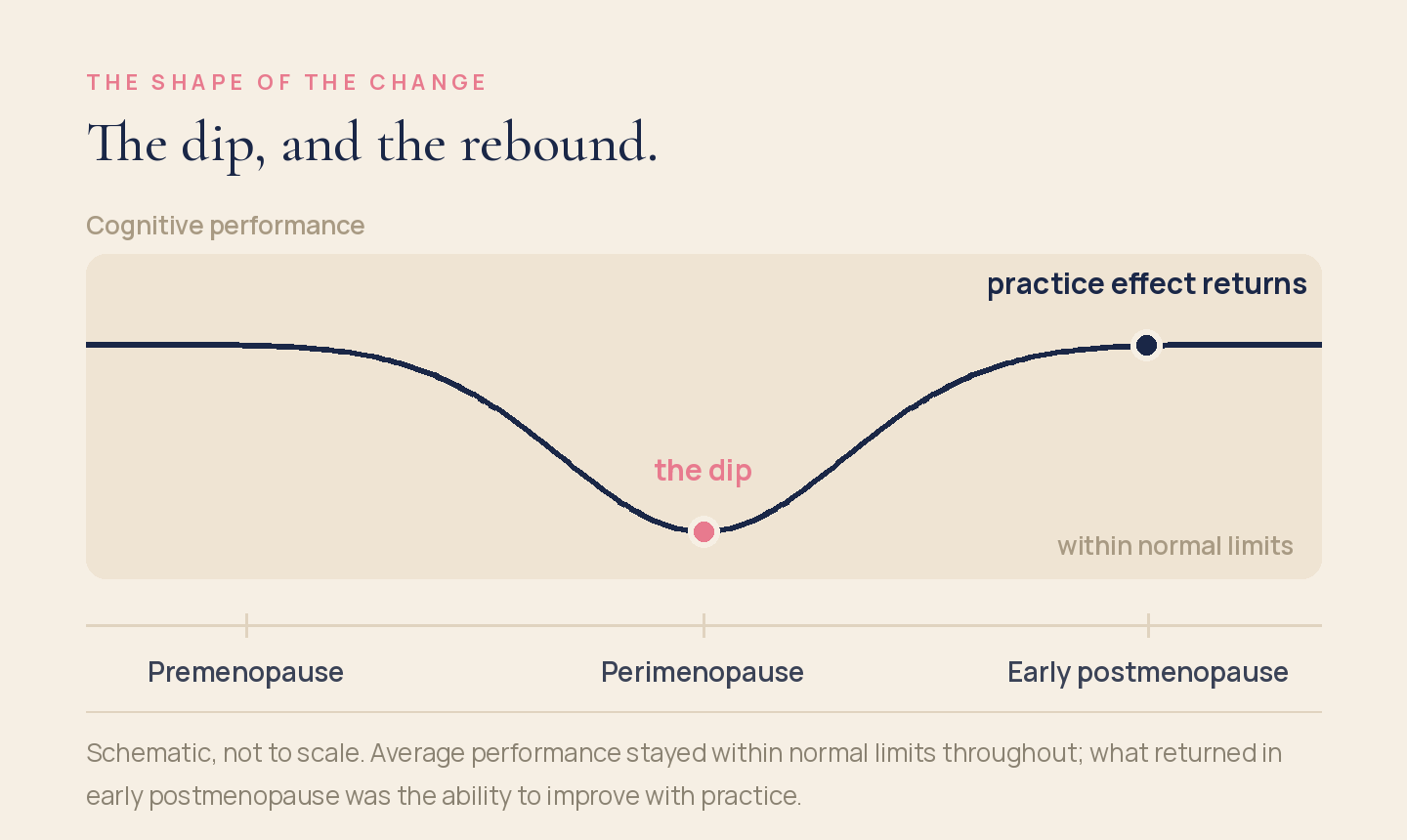
In the largest long-running study of the menopause transition, women's cognitive performance did dip during perimenopause — the most consistent findings being in processing speed and in verbal learning and memory, exactly the word-finding and name-recall that women describe. But two details matter enormously.
First, average performance stayed within normal limits. This is not the pattern of a neurodegenerative disease.
Second, it appears to be largely time-limited. During perimenopause, women temporarily lost the normal ability to improve on repeated cognitive tasks with practice — and on objective testing, that capacity came back in early postmenopause. Symptoms don't always resolve on the same timeline as test scores. But the trajectory is toward recovery, not decline.
Dementia before the mid-sixties is genuinely rare. Brain fog in your forties and fifties is genuinely common. Those two facts, held together, are the answer to the 2 a.m. Google search.
What else can look exactly like this
Here is the part that gets skipped. Hormonal turbulence is one contributor to midlife brain fog — rarely the only one. Before we attribute everything to perimenopause, it's worth ruling out the things that are eminently fixable:
- Fragmented sleep. Waking at 3 a.m. — whether from night sweats or not — degrades next-day processing speed and memory consolidation. Often the biggest contributor to how the day actually feels, and the most modifiable.
- Thyroid dysfunction, which becomes more common in midlife women and mimics cognitive symptoms closely.
- Iron deficiency and low B12. Low B12 can affect the nervous system well before anemia appears; low iron is a well-documented cause of fatigue and is worth checking when stamina is the problem.
- Depression and anxiety, which measurably impair performance on cognitive testing.
- Obstructive sleep apnea, which is underdiagnosed in women and often presents as fatigue and fog rather than loud snoring.
- Medications and alcohol. Antihistamines, some sleep aids, and even a nightly glass of wine take a real toll on sleep architecture.
- Cardiometabolic health. Elevated blood glucose — and, less consistently, blood pressure — predicts faster decline in processing speed through midlife. It's one of the more actionable findings in this literature.
Most of that list is a blood draw and a conversation away. Book an appointment and we’ll work through it properly.
What actually helps
Protect sleep first; it has the highest return of anything on this list. Treat the vasomotor symptoms that are fragmenting it. Train strength — muscle is metabolically active tissue, and blood sugar is one of the few midlife cognitive risk factors you can genuinely move. Keep alcohol modest. Correct the deficiencies that testing actually finds, rather than guessing.
On hormone therapy, accuracy matters: major menopause societies do not recommend hormone therapy for the sole indication of cognitive symptoms, because trials in early postmenopausal women showed neutral effects on cognition. That said, when hormone therapy resolves the night sweats that are shattering your sleep, many women describe the fog lifting as a downstream effect. That's a real and worthwhile conversation — it's just a different conversation than "hormones for memory."
You may have seen that the FDA removed the dementia language from hormone therapy labeling in 2026. That's a change in how the risk is framed — not a new indication for memory.
What about supplements — and peptides?
This is where the internet gets loud, so let me be specific about what has evidence behind it and what doesn't. Three come up constantly.
Creatine. The best supported of the three, and the one most people are surprised by. Creatine isn't only for muscle — the brain uses it as an energy buffer, and brain creatine stores fall under sleep deprivation and mental fatigue, which is precisely the state a lot of perimenopausal women are living in. A 2026 systematic review of creatine and cognition in older adults found that five of six studies reported better memory or attention with supplementation.
The honest caveat: that same review rated half the studies poor quality, the two intervention trials disagreed with each other, and there is no trial yet in perimenopausal women specifically. Typical dose in the research is 5 g/day of creatine monohydrate. It's inexpensive, well tolerated, and it does double duty alongside strength training — which is why it's the one I'm most comfortable discussing.
NAD+ precursors — NR and NMN. That these raise NAD+ levels in humans is settled. Whether raising NAD+ improves cognition in humans is not: the trials are small, inconsistent, and the compelling results are largely from animal models. There's also a regulatory footnote worth knowing, because it confused the market for two years — the FDA had treated NMN as excluded from the definition of a dietary supplement, then reversed that position in September 2025. So it's lawfully available again. "Lawfully available" is not the same as "shown to work."
Semax. This is the one I'm asked about most. Semax is a peptide developed in Russia — a fragment analog of ACTH — used there for stroke and cognitive indications, and for a lot of women it's the doorway into the peptide conversation generally.
That's a conversation we're glad to have. We counsel patients on peptides individually, and what we recommend depends less on the peptide itself than on what's underneath it — whether sleep, thyroid, iron, glucose, and hormones have been sorted out first. Peptides tend to be a considered addition to a foundation that's already in place, rather than a substitute for building one. When the foundation is solid and someone still wants to explore further, that's a reasonable place to look together.
Where things currently stand, so you're not surprised: Semax isn't FDA-approved in the United States, and it isn't sold here as a dietary supplement. Its status as a compounding ingredient is being decided right now — FDA's Pharmacy Compounding Advisory Committee reviewed it on July 24, 2026 for possible inclusion on the 503A bulks list, nominated for cerebral ischemia, migraine, and trigeminal neuralgia. There's no published trial in menopausal cognitive symptoms yet.
None of that puts it off the table — it means the details matter. Which pharmacy is compounding it, a 503A pharmacy or a 503B outsourcing facility. What is verifiably in the vial. How it's dosed, and how the regulatory picture is moving, because it's moving quickly. Those are the things we walk through together, which is why peptides belong in a conversation rather than a checkout page.
If you want the supplement piece
We keep a brain fog and cognition protocol in our dispensary — the products we most often talk through with patients working on sleep quality, energy, and cognitive support. It's there so you're choosing from a vetted shortlist instead of a search result.
Supplements are not a treatment for brain fog, and they're not a substitute for finding out what's actually driving it — start with the workup. Wahine Health has a financial relationship with Fullscript.
One more reason to take night sweats seriously
There's a newer line of research here that deserves careful language, because the headline version of it is misleading.
When researchers measured hot flashes objectively — with a skin-conductance monitor rather than a symptom diary — women having more hot flashes during sleep showed a plasma amyloid-beta pattern of the kind associated with Alzheimer's risk, and a greater burden of small white-matter lesions on brain imaging. Self-reported hot flashes showed no such association. It appears to be what the body registers overnight, not what you remember in the morning, that tracks.
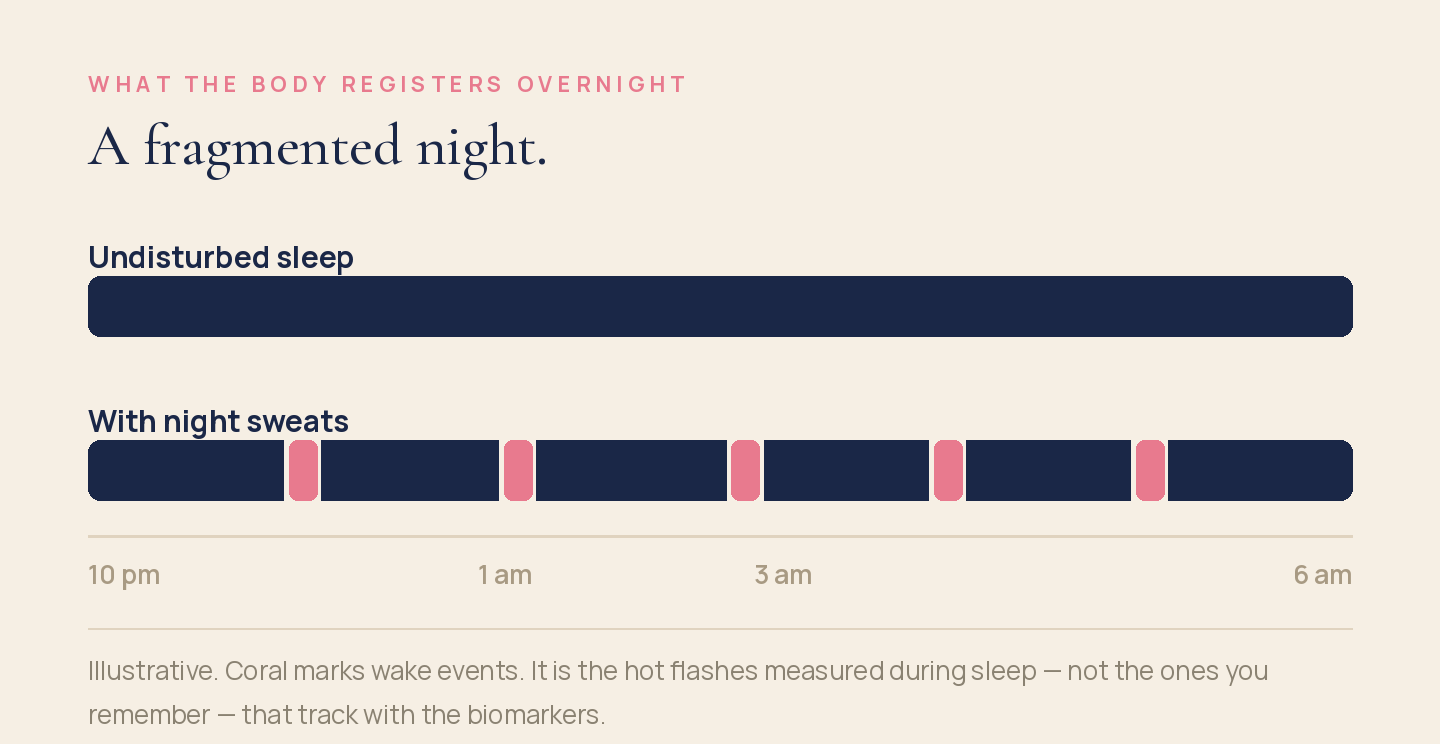
Hot flashes do not cause dementia. Frequent nocturnal hot flashes look like an early marker of vascular and inflammatory vulnerability — a signal, not a cause.
That distinction matters enormously, and I want to be direct about it: this is correlation. Nobody has shown that treating hot flashes prevents dementia. If you are already lying awake worrying about your memory, this finding is not a reason to worry more.
What it does change is how seriously we should take night sweats. They are not merely a comfort problem to be endured until they pass on their own. They fragment the sleep that your next-day memory depends on, and they appear to travel with the cardiovascular and inflammatory factors that shape long-term brain health. That makes them one of the more worthwhile things on this list to actually treat — and one of the few midlife risk markers that may be modifiable.
Which is why, when a woman tells me about brain fog, one of the first questions I ask is how many times a night she's waking up hot.
Three questions worth answering honestly
Most women wait far too long on this one, because "I'm forgetting things" feels like a complaint rather than a symptom. It isn't. If you're not sure whether what you're experiencing is worth an appointment, these three questions sort it faster than another 2 a.m. search:
- Is it changing how you work? Re-reading emails to retain them. Writing things down that you never used to. Declining the presentation, the meeting, the thing you'd normally say yes to — because you don't quite trust your recall.
- Is it steadily getting worse, rather than coming and going? Perimenopausal fog tends to fluctuate — worse in a bad week of sleep, better in a good one. Fog that only moves in one direction is a different conversation.
- Has anyone actually checked the basics in the past year? Thyroid, B12, iron, sleep, mood, medications. If the answer is no, you don't have a diagnosis yet — you have an assumption.
One yes is reason enough to be seen. It doesn't mean something is wrong. It means it's worth looking properly.
You don't have to keep wondering
You deserve better than reassurance alone — you deserve a real evaluation. We'll take a full history, work through what else could be driving it, order the labs that are actually indicated, and talk honestly about what will and won't help.
That's an ordinary appointment here. Most women leave with a plan and, for the first time in months, a straight answer.
Ready when you are
Let's find out what's actually going on.
Same-week appointments are often available. Bring the questions you've been Googling — we'd genuinely rather answer them here.
Book an appointment Call (808) 879-1859Rather write than call? Send us a message and we'll get back to you.
Not ready to book? Start here.
Our free, private 3-minute check-in walks you through the symptom pattern we look for. It's education, not a diagnostic test — but it will tell you whether your symptoms cluster the way perimenopause usually does.
Take the symptom check-in