
Nothing changed, and everything changed. You eat the way you always have. You move the way you always have. And somewhere in the last two or three years the weight moved to your middle, your energy flattened by mid-afternoon, and the jeans that fit in spring stopped cooperating by fall. So you ask the question almost every woman in her 40s and 50s eventually asks: is this menopause, or is something wrong with my metabolism?
The honest answer is that the question has a false floor in it. In midlife, menopause is a metabolic event. But the question still matters — a great deal — because “it’s probably hormones” and “it’s probably my metabolism” are both ways of not checking. And November, with a deductible that resets on January 1 and a schedule that fills before the holidays, is the right month to stop guessing.
What menopause does to your metabolism
Estrogen is not only a reproductive hormone. It helps decide where fat is stored, how muscle responds to the work you give it, and how sensitive your cells are to insulin. As estrogen falls through the transition, three things shift more or less at once, and they shift even when the number on the scale does not:
Fat moves to the middle. The long-running SWAN study of women crossing the menopause transition found that fat mass begins climbing and lean mass begins falling roughly two years before the final period, and that the shift in body composition — less muscle, more visceral fat around the organs — happens independently of total weight. A woman can weigh what she weighed at 40 and carry it in an entirely different, and metabolically more active, place.
Muscle stops answering the way it used to. Estrogen is also a muscle hormone. Lose it and the same workout builds and maintains less. (That post is here.)
Insulin sensitivity drifts down. Less muscle and more visceral fat together mean the body needs more insulin to do the same job. For many women this is the decade in which fasting glucose and A1c begin quietly creeping, long before anyone says the word “prediabetes.”
Same number on the scale
Where the weight lives changes across the transition
Layer on the sleep disruption of the transition — the 3 a.m. wake-ups — and the appetite-hormone shifts that come with short sleep, and you have a complete explanation for what you are feeling that involves no failure of willpower at all.
What else looks exactly like this
Here is why “it’s just menopause” is not a safe place to stop. Several conditions produce the same picture — fatigue, central weight gain, sleep that does not restore, a mood that has lost its margin — and every one of them is easy to miss if nobody looks, and treatable if somebody does.
Prediabetes and insulin resistance. November is National Diabetes Month for a reason. Roughly one in three American adults has prediabetes, and the large majority do not know it, because it produces no symptoms you would recognize as “blood sugar.” What it produces is exactly the midlife picture above. It is also the single most reversible finding on this list.
Thyroid. An underactive thyroid slows metabolic rate, causes weight gain, fatigue, cold intolerance, hair shedding and mood change, and it peaks in this decade of a woman’s life.
Iron deficiency. Years of heavier perimenopausal periods drain the iron stores long before anemia appears. Low ferritin alone will flatten your energy and your workouts.
Sleep apnea. It rises sharply in women after menopause, rarely looks the way it does in men, and drives both weight gain and insulin resistance directly.
Medications. Several common prescriptions — some antidepressants, beta-blockers, steroids, certain antihistamines and sleep aids — cause weight gain on their own.
Liver and lipids. Fat accumulating in the liver (now called MASLD) and a rising LDL cholesterol are both common consequences of the estrogen drop, both silent, and both worth knowing about now rather than in ten years.
One picture, several causes
The same symptoms, six different explanations
None of this is a reason for alarm. It is a reason for a thoughtful set of labs, drawn once, read in context.
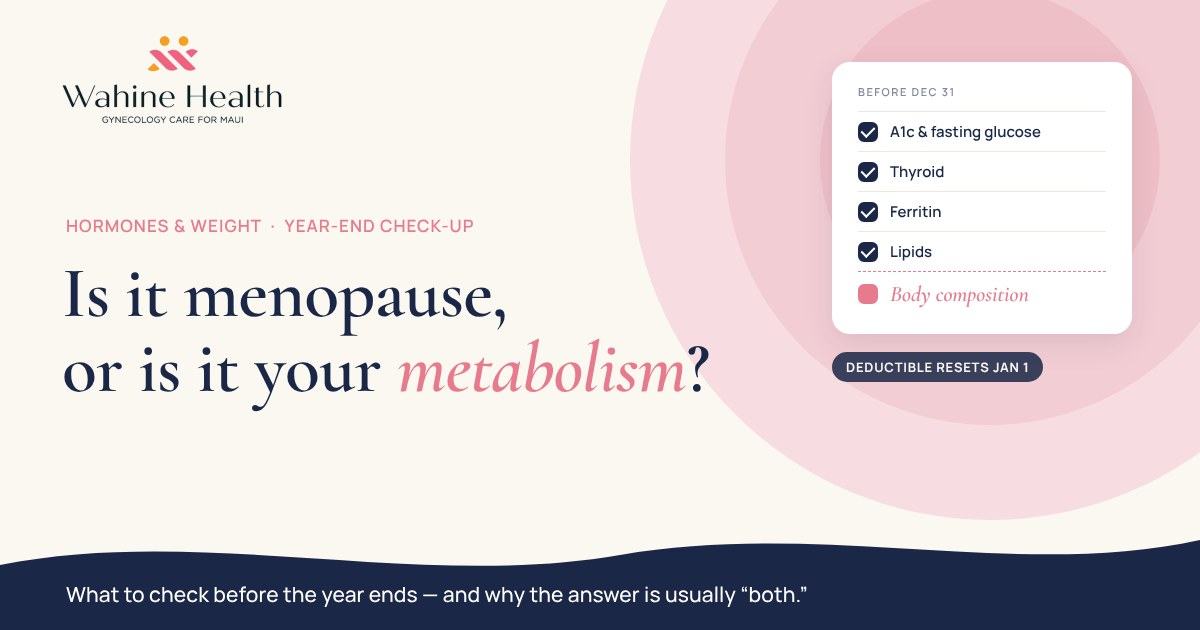
What to check before the year ends
This is the list I want most of my patients to have a current answer to before December 31. Not every item applies to every woman — which ones belong on your order is a decision made at the visit, not from a blog post — but it is the right conversation to walk in with.
- A1c and fasting glucose, and in many cases a fasting insulin, because insulin rises years before glucose does.
- Lipid panel — total, LDL, HDL and triglycerides. LDL climbs at menopause even in women whose diet has not changed.
- Thyroid — TSH, with free T4 when the picture warrants it.
- Ferritin and a blood count, not hemoglobin alone.
- Vitamin D, and B12 when indicated.
- Liver enzymes, which is how fatty liver first announces itself.
- Blood pressure and waist circumference, measured, not estimated. Waist tells you more about metabolic risk than BMI does.
- Body composition — muscle mass, fat mass and visceral fat, rather than a scale. This is the number that actually tracks what menopause is doing to you, and the one that tells us whether what we do next is working.
- Bone density, if you are 65 or older, or younger with risk factors — early menopause, a parent with a hip fracture, long-term steroid use, low body weight or a prior fracture.
Your year-end checklist
Have a current answer to each of these
- A1c and fasting glucose — often with a fasting insulin
- Lipid panel — LDL climbs at menopause on an unchanged diet
- Thyroid — TSH, free T4 when warranted
- Ferritin and a blood count — not hemoglobin alone
- Vitamin D, B12 when indicated
- Liver enzymes — how fatty liver first shows up
- Blood pressure and waist — measured, not estimated
- Body composition — muscle, fat and visceral fat, not a scale
- Bone density — 65+, or younger with risk factors
Already have one of these from this year? Tap it to clear it — what’s left is your list for the visit. Which items belong on your order is decided with your clinician. Printable version (PDF)
What is deliberately not on the list: a one-time estradiol or FSH to “confirm” perimenopause. If you have already been told your hormone levels are normal and wondered why you still feel like this, that post explains why. The diagnosis is clinical. The labs above are for everything the diagnosis could be hiding.
Why we check insulin, not just sugar
Insulin rises years before glucose crosses a line
Why before December 31, specifically
Three practical reasons, none of them medical.
Your deductible. If you are on a calendar-year plan — most are — whatever you have paid toward your deductible this year resets to zero on January 1. A visit and a set of labs you have already been meaning to get cost you less in December than the identical visit and labs will in January. If you are in-network with us (HMAA/HWMG or UHA) that applies to the visit directly; if you are out-of-network, it applies to any out-of-network benefit your plan carries, and we submit the claim for you. Either way, lab work itself is usually billed by the lab to your own insurance. (Details are on our billing and insurance page; your plan is the final word, so a quick call to them is worth making.)
Your FSA or HSA. Flexible spending accounts are largely use-it-or-lose-it at year end, and a health savings account can be spent on the visit, the labs and the body composition analysis.
The calendar. December schedules fill, and January brings everyone who decided on New Year’s Day. A baseline drawn now means we spend January acting on results instead of waiting for them.
Book a year-end visit — Wailea or telehealthIn office in Wailea, or by telehealth in Hawaiʻi & Illinois. Current patients: this is the right time for your annual.
What we do with the answers
This is where having a physician board-certified in both gynecology and obesity medicine in the same room changes the conversation, because the results do not get split between two offices that never talk to each other. (The case for treating hormones and metabolism as one conversation is one I have made before.) In practice:
If perimenopause or menopause is driving the picture and you are a candidate, hormone therapy is discussed on its own merits — for sleep, for hot flashes, for the joint and mood symptoms — and the evidence is reassuring that it does not cause weight gain and may blunt the shift of fat to the middle. It is not a weight-loss treatment, and we do not prescribe it as one.
If insulin resistance or prediabetes is on the table, the first prescription is muscle: enough protein, and resistance training that is actually progressive. It is unglamorous and it is the most powerful metabolic lever a midlife woman has.
If the thyroid, iron, sleep or a medication turns out to be the culprit, we treat that, and the “menopause weight” often turns out to have had a different name.
And when the picture warrants it, FDA-approved GLP-1 medication is one option among several — prescribed in context, monitored for muscle loss, and never as the whole plan. Our Hormones & Weight page explains how we think about it and, just as importantly, what we will not do.
What to say when you book
You do not need to arrive with a diagnosis. You need a sentence:
“My weight and energy have changed over the last couple of years and I’d like to look at hormones and metabolism together before the end of the year — a full set of labs and a body composition baseline.”
Bring a list of your medications and supplements, a rough timeline of what changed and when, and if you have not already, the 3-minute symptom check-in on this site.
Download the printable year-end checklist (PDF)
Where that leaves you
Menopause or metabolism is the wrong fork in the road, because at 48 or 55 they are the same road. The useful question is which parts of this are hormonal, which parts are metabolic, which parts are something else entirely — and what are we going to do about each one? That question has an answer. It takes one visit, one set of labs, and a clinician willing to read them as a whole. The calendar says this is the month to ask it.
Common questions
Does menopause actually slow your metabolism? Resting metabolic rate declines only modestly across the transition. The bigger changes are in body composition — less muscle, more visceral fat — and in insulin sensitivity, both driven by falling estrogen. Those shifts change how your body handles the same food and the same exercise, which is why it feels like your metabolism “broke” even though the calorie math barely moved.
What blood tests should a woman in perimenopause get for weight gain? The useful ones rule out and quantify metabolic causes: A1c and fasting glucose (often with fasting insulin), a lipid panel, thyroid function, ferritin and a blood count, vitamin D, and liver enzymes — along with blood pressure, waist circumference and ideally a body composition analysis. A single estradiol or FSH level does not help answer the weight question.
Can I have prediabetes with a normal weight? Yes. Visceral fat and loss of muscle raise insulin resistance regardless of total weight, and midlife women with a “normal” BMI are frequently surprised by an A1c in the prediabetic range. That is one reason waist circumference and body composition are more informative than the scale.
Will hormone therapy help me lose weight? Hormone therapy is not a weight-loss treatment and is not prescribed for that purpose. The evidence shows it does not cause weight gain and may reduce the shift of fat to the abdomen, and by improving sleep and hot flashes it can make the things that do move weight — training, protein, recovery — easier to sustain.
Why does it matter whether I do this before the end of the year? Medically, it does not have to be December. Practically, most insurance deductibles reset on January 1, FSA funds often expire at year end, and schedules fill before the holidays — so a visit and labs you are already planning tend to cost less and happen sooner if you book them now.
Hormones & Weight · Wailea, Maui
Stop guessing before the year ends.
One visit, one set of labs, one body composition baseline — read together by a physician board-certified in both gynecology and obesity medicine. In office in Wailea, or an initial visit by telehealth.
Book a year-end visit How we approach hormones & weight Take the 3-minute symptom check-in