
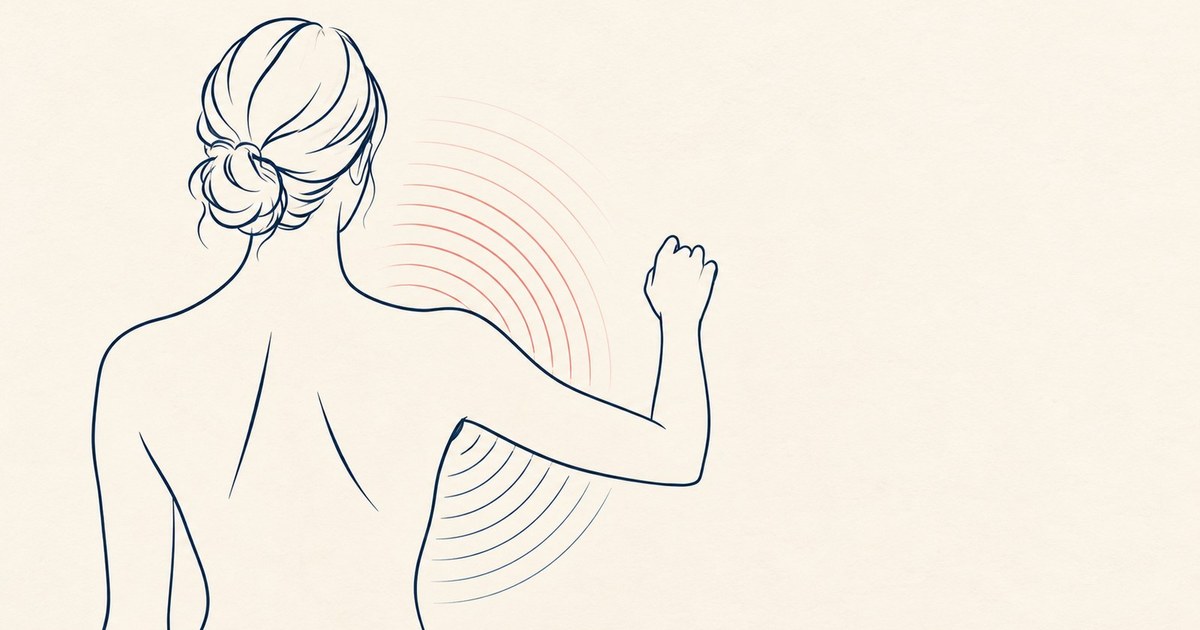
You woke up one morning and your shoulder wouldn't lift past your ear.
Or your hips ache when you get out of the car. Or your hands are stiff for the first twenty minutes of the day, and your knees complain on the stairs at Kamaʻole, and you have started saying "I must have slept on it wrong" three or four times a week.
You are 47, or 52, and nothing happened. There was no injury. There was no fall. The X-ray is unremarkable and the inflammatory labs are normal and you have been handed a prescription for physical therapy and a vague suggestion that this is what your forties feel like.
That may not be what your forties feel like. For a great many women, it is what falling estradiol feels like — and almost nobody makes that connection out loud.
There is a name for this now
In 2024, a group of physicians published a paper in Climacteric proposing a name for a cluster of symptoms that clinicians had been seeing for decades without ever connecting: the musculoskeletal syndrome of menopause. Joint pain. Stiffness. Loss of muscle. Accelerated bone loss. Cartilage changes and osteoarthritis progression. Frozen shoulder. A meaningful share of it downstream of one hormone leaving.
More than 70% of women will experience musculoskeletal symptoms across the menopause transition, and roughly 25% will be disabled by them — the authors' word, not a softening of it. In the Study of Women's Health Across the Nation, one of the largest long-term studies we have on midlife women, about three-quarters of women reported joint pain or stiffness, and about a quarter rated it moderate to severe.
The American Academy of Orthopaedic Surgeons now has a patient page for it. That is worth pausing on: the orthopedic surgeons have recognized this before most primary care offices have.
Estrogen is a joint hormone
We talk about estrogen as a reproductive hormone, which is a little like calling the ocean a place to park your board. Estrogen receptors are everywhere — brain, bone, blood vessels, skin, and throughout the musculoskeletal system.
Estradiol, the dominant estrogen in your reproductive years, does at least four things that matter here:
It regulates inflammation. Estradiol is an anti-inflammatory signal. When it falls, the inflammatory tone of your tissues rises — and generalized joint pain, what we call arthralgia, is often the first thing you feel.
It maintains collagen. Estrogen supports collagen production and the health of connective tissue. This is the same reason your skin changes at menopause; the change is happening in tendons, ligaments and joint capsules too. Less collagen support, more stiffness, slower repair.
It protects muscle. Estradiol supports muscle maintenance and the satellite cells — the muscle stem cells your body uses to repair and rebuild. When it drops, sarcopenia (age-related muscle loss) accelerates. You are not imagining that the same workout does less than it used to.
It protects bone. Bone loss accelerates sharply in the years immediately around your final period — on the order of 2% per year beginning about a year before the last menstrual period. This is the piece you cannot feel, which is exactly why it matters.
Book a visit — Wailea or telehealthIn office in Wailea, or by telehealth in Hawaiʻi & Illinois.
The frozen shoulder question
Frozen shoulder — adhesive capsulitis — deserves its own section, because it is the symptom that sends women to the wrong specialist most often.
The ache doesn't sit still. It radiates, it fades, it comes back.
It affects women more often than men — most series report roughly one and a half to two times as often — and it peaks between ages 40 and 60. Those facts have been in the orthopedic literature for years without anyone routinely drawing the line to the menopause transition.
Here is the proposed mechanism: without adequate estradiol, inflammation and fibroblast activity in the joint capsule go relatively unchecked. Fibroblasts lay down stiff, scar-like tissue. The capsule thickens and contracts. And it can happen with little or no trauma — which is precisely why it feels so bewildering. Nothing happened to your shoulder.
One important caveat. Estrogen is not the only driver here, and I would be doing you a disservice to imply it is. Frozen shoulder is strongly associated with diabetes — prevalence runs roughly 10–30% in people with diabetes versus 2–5% in the general population — and with thyroid disease. That is a large part of why a frozen shoulder in your late forties deserves an actual workup rather than an assumption in either direction. It belongs in a conversation about your menopause transition and in a conversation about your metabolic and thyroid health. Those should be the same conversation.
When to be evaluated sooner rather than later
Reframing joint pain as hormonal is useful. It is also worth naming what should not be reframed. Please have these looked at promptly rather than filed under midlife:
Joint swelling, redness or warmth · fever alongside joint pain · morning stiffness lasting more than an hour · pain following an injury or fall · pain that is severe, rapidly worsening, or in a single joint · any new weakness or numbness.
Those patterns point somewhere other than this syndrome, and they deserve their own evaluation.
What can actually be done
This is education rather than a treatment plan for any individual — what is right for you depends on your history, your risk factors, and a real conversation. But here is the honest landscape.
Load your muscles and your skeleton. For most midlife women this is the highest-yield place to start. Resistance training is among the best-evidenced interventions for the muscle and bone components of this syndrome. Bone responds to being loaded. Muscle responds to being challenged. Walking is wonderful for your heart and it is generally not sufficient for this — progressive resistance, something that gets harder over time, is what the tissue is asking for.
Eat enough protein. Many midlife women are undereating protein by a wide margin, often as a leftover habit from a decade of dieting. Protein is the raw material for the muscle you are trying to keep.
Check that your vitamin D is adequate. Correcting a true deficiency matters for muscle function; supplementing well beyond sufficiency has not been shown to add benefit. This is a "know your number" item rather than a "take more" item.
Creatine, alongside resistance training, is worth asking about. The evidence supports it for building and maintaining muscle mass when paired with strength training. It has not been shown to improve bone mineral density directly — any bone benefit is secondary to the muscle and loading it supports.
Put hormone therapy in the conversation, if it is already on the table. In the Women's Health Initiative, women on hormone therapy reported modestly less joint pain, and symptoms increased again after stopping. The effect was real but small on average. To be precise about the rest: hormone therapy is not FDA-approved for treating joint pain, and musculoskeletal symptoms alone are not by themselves a reason to start it. But if you are already weighing hormone therapy for hot flashes, sleep or genitourinary symptoms, your musculoskeletal symptoms belong in that same conversation rather than being handled in a separate silo by a separate specialist.
And please don't let 65 be the default
This is the one I want to be direct about. Age 65 is when bone density screening is routinely covered for average-risk women. It is not a biological deadline, and it is not a rule that you have to wait — and as the chart below shows, the steepest loss happens in the years right around your final period, a decade or more before that.
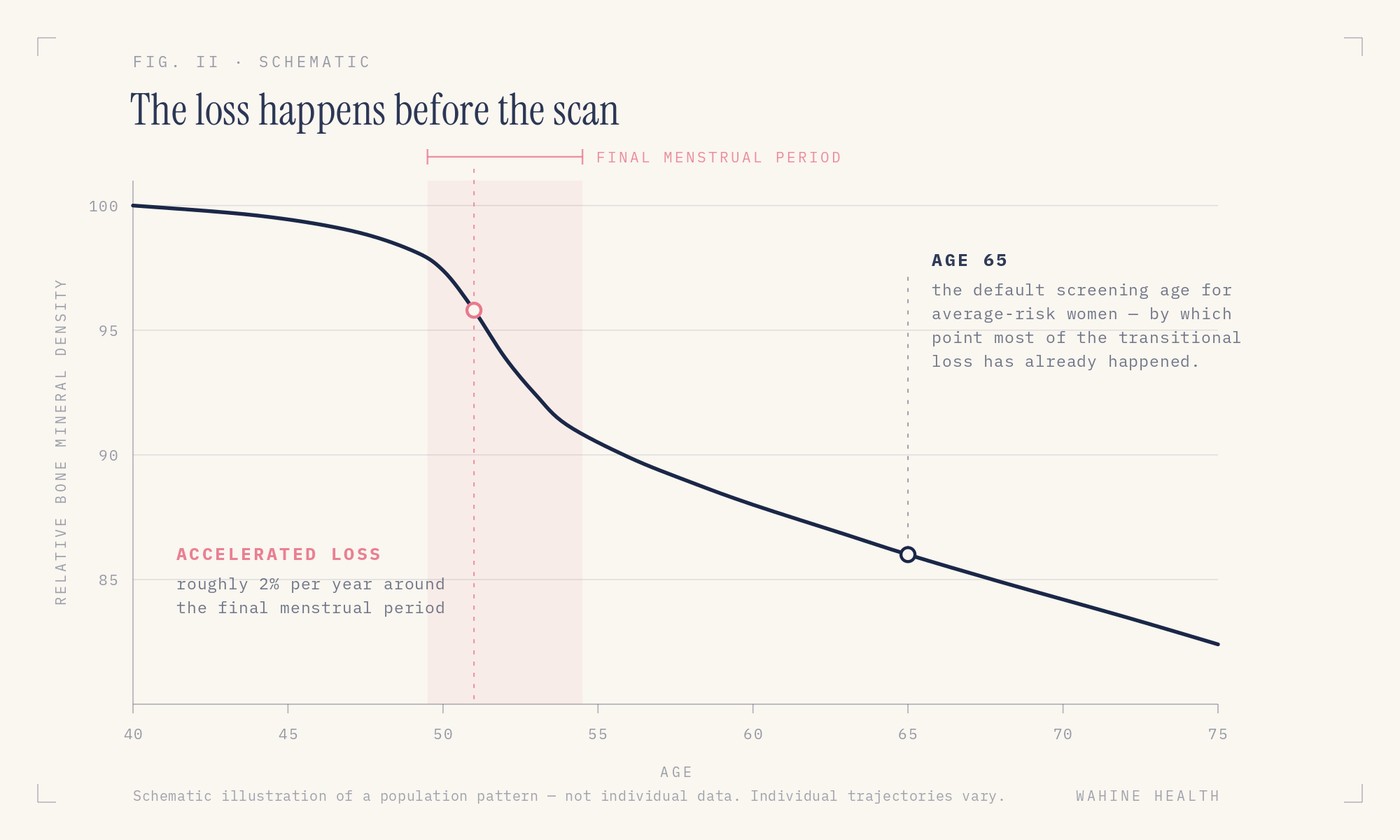
Schematic illustration of a population pattern — not individual data. Individual trajectories vary.
If you went through menopause early, if you're thin or have a family history of osteoporosis or hip fracture, if you've used steroids long-term, smoked, or already broken a bone as an adult, earlier testing is worth a conversation. And if we can't get it covered for you, we keep reasonably priced self-pay options — the cost of the scan should not be the reason you don't know your number.
Bone loss is the one part of this syndrome that gives you no symptoms at all until something breaks. It's also the one where knowing early actually changes what you can do about it.
What I want you to take from this
Two things.
First: your pain is real, and for many women in this stage of life there is a mechanism behind it that has gone unnamed. You are not being dramatic and you are not simply getting old.
Second: much of this is modifiable — but only if someone connects it to the right systems. If you have been going from orthopedics to physical therapy to rheumatology and back with normal labs and a shrug, the missing piece may be sitting in your endocrine and metabolic history rather than in your joints.
Common questions
What is the musculoskeletal syndrome of menopause? A name proposed in 2024 for a cluster of symptoms driven by falling estradiol — joint pain, stiffness, muscle loss, accelerated bone loss, arthritis and frozen shoulder. More than 70% of women experience musculoskeletal symptoms through the transition; about 25% are disabled by them.
Is frozen shoulder related to menopause? It affects women more often than men and peaks between 40 and 60, overlapping the transition. Estrogen appears to be part of the mechanism — but diabetes and thyroid disease carry strong associations too, so it deserves a real workup.
Does hormone therapy help joint pain? In the WHI, women on hormone therapy reported modestly less joint pain, and it increased again after stopping. Real but small on average. It is not FDA-approved for musculoskeletal symptoms, and joint pain alone is not a reason to start it.
When should I get my first bone density scan? 65 is when it's routinely covered for average-risk women — not a biological deadline. Earlier testing is worth discussing with early menopause, a thin build, family history, long-term steroids, smoking, or a prior adult fracture. We keep reasonably priced self-pay options when a scan isn't covered.
Joints · Muscle · Bone
Have it all looked at together.
Your cycles, your sleep, your bone density, your muscle, your thyroid, your metabolic health — in one conversation, with a physician who is board-certified in obstetrics and gynecology and certified by The Menopause Society. In office in Wailea, or by telehealth.
Book a visit Menopause & hormone therapy Take the 3-minute symptom check-in